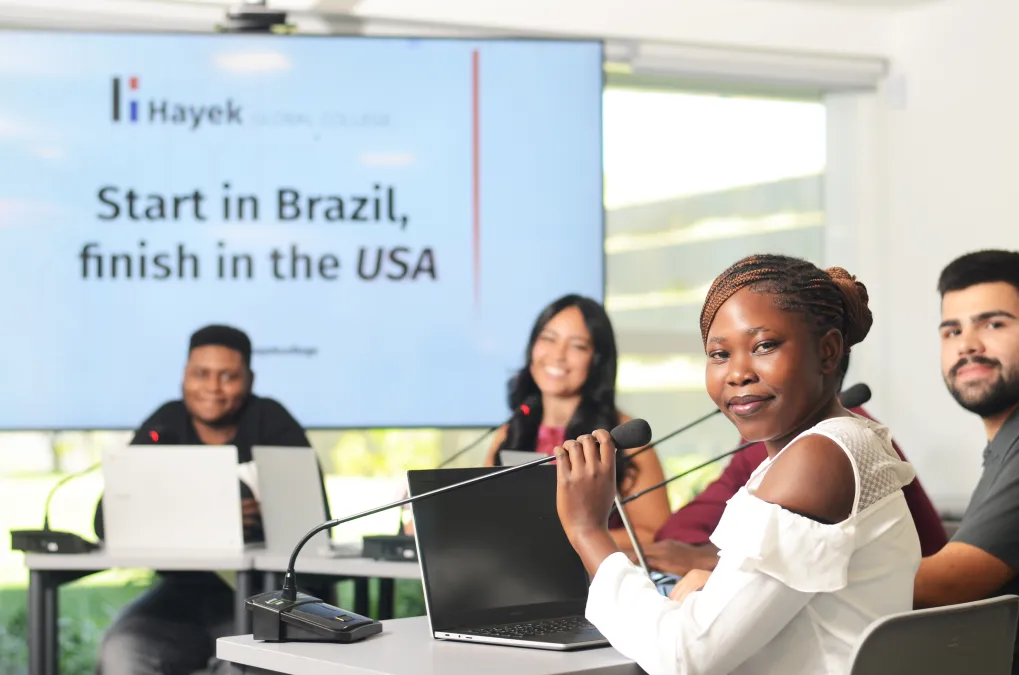
Hayek Global College, an international higher education institution based in Brasília, is currently accepting applications for its American College program, an innovative dual-degree undergraduate program between Brazil and the U.S.
Under the 2+2 format, students complete their first two years in Brazil following an American curriculum and then transfer to a partner university in the United States to complete the final two years of their degree. Upon graduation, students earn a bachelor’s degree in fields such as Computer Science, Business Administration, Finance, Accounting, Economics, Marketing, International Relations, and other areas. Partner universities in the United States include Cumberland University, Clark University, Alfred State University, Fort Hays State University, among others.
At Hayek, all classes are taught 100% in English and follow active learning methodologies and interdisciplinary projects, including the Collaborative Online International Learning (COIL) model, which connects students, professors, and peers from international institutions through joint academic activities.
The admissions process consists of two stages:
In the first stage, applicants take Mathematics and English exams. Students with AP or IB credits or strong scores on standardized tests such as the SAT, TOEFL, or IELTS may be exempt from this stage.
The second stage includes an academic transcript review, submission of a video pitch of up to three minutes, participation in a simulated class activity, and portfolio presentation.
“A portfolio is a fundamental tool for anyone seeking to build an international career. It allows students to showcase not only their academic performance but also experiences that demonstrate their ability to operate in diverse cultural and professional contexts. In an increasingly interconnected world, universities and companies value candidates with diverse backgrounds who know how to turn knowledge into action,” says Edson Agatti, Executive Director of Hayek Global College.
For the application, the student’s portfolio should include activities completed in the classroom, such as research project presentations, group assignments, or other initiatives that demonstrate the ability to apply theoretical concepts to practical situations. Experiences outside the academic environment are also highly valued, including sports, music, volunteer work, exchange programs, social projects, or part-time jobs. Hobbies such as reading, video games, and other leisure activities may also be included. “It is essential to provide details and supporting evidence, such as photos, videos, and certificates,” the director emphasizes.