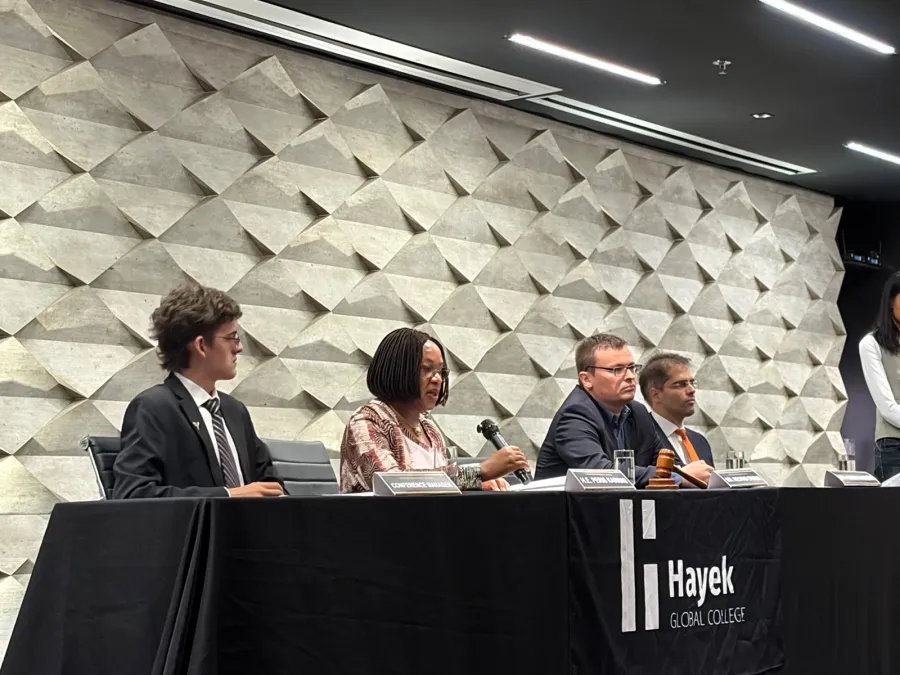
On October 2, Hayek Global College hosted the second edition of the Hayek Global International Model United Nations (HGI MUN), in partnership with Internationali Negotia. The initiative brought students together for a United Nations simulation, providing a hands-on opportunity to debate international relations, diplomacy, and geopolitical issues.
The event featured Peris Kariuki, Ambassador of the Republic of Kenya, and Heorhii Erman, First Secretary at the Embassy of Ukraine in Brazil. Both diplomats shared professional experiences and insights into the challenges of contemporary diplomacy.
Diplomacy as an Exercise in Listening and Negotiation
During her participation, Peris Kariuki emphasized that experiences such as HGI MUN help students develop skills that go beyond the knowledge traditionally acquired in the classroom. For the ambassador, the simulation can also provide an opportunity for self-discovery.
“This simulation is an opportunity for self-discovery. In the classroom, there is a dynamic in which the teacher leads the activities, but when students step outside that environment, they need to develop new skills. This generation has a very important role to play because it lives in the age of technology and is more connected and open to new ideas. This can help them find new solutions to the challenges we face,” she noted.
Speaking about diplomatic work, Kariuki also highlighted the importance of balancing the ability to defend a position with an openness to understanding different perspectives.
“It is important for these young people to speak with confidence, but listen carefully. They should defend their positions while remaining willing to understand the other side.”
According to the ambassador, these are essential skills in diplomacy, which involves representing interests, listening to different viewpoints, negotiating, persuading, and seeking compromise.
“The most successful diplomat is not necessarily the one who speaks the most or the one who wins the argument. Sometimes, it is the one who listens carefully enough to find the compromise that everyone else has overlooked.”
Diplomatic Experience and the Changing International Landscape
Heorhii Erman also shared his experience with diplomatic simulations, highlighting the importance of initiatives like HGI MUN in helping students understand international challenges.
“It is a very important project. Twenty years ago, I was exactly where you are now. I was responsible for a Model United Nations conference project at the Institute of International Relations in Kyiv, the capital of Ukraine. So I can say that the project you are participating in now is an opportunity to gain a deeper understanding of the crises taking place around the world and to think about what may happen in the coming years,” he said.
The First Secretary also explained that participating in a UN simulation allows students to learn about different countries, understand their national interests, and improve their command of English, which he considers an important tool in an increasingly interconnected international environment.
Drawing on his own experience, Erman reflected on the changes the world has undergone over the past two decades. According to him, the international landscape has experienced significant transformations, particularly with the growth of technology companies and their increasing economic and political influence.
The diplomat also discussed the changes Ukraine has experienced over recent decades. He recalled that, 20 years ago, the country was going through a period of economic prosperity and that the prospect of a full-scale war was not part of the population’s expectations.
Commenting on the evolution of the Russia-Ukraine conflict, Erman stressed the importance of understanding the signs and changes in the international landscape before crises escalate.
“For any diplomat, for anyone who wants to develop a career in diplomacy, international trade, or any other field, it is very important to think about the future and what may change in the coming years.”
Brazil and the Challenges of International Cooperation
During his remarks, Heorhii Erman also discussed Brazil’s position on the international stage. In the diplomat’s view, the country is in a particularly favorable position because many of its territorial disputes have historically been resolved.
Erman referred to the work of Baron of Rio Branco, a leading figure in Brazilian diplomacy in the early twentieth century, and highlighted Brazil’s opportunities for peaceful development and international cooperation.
“Brazil has a very positive image around the world, which is relatively uncommon among large countries with continental dimensions.”
The First Secretary also emphasized the importance of building connections between students from different countries. In his view, these relationships can contribute to a broader understanding of international realities, national interests, and the challenges facing younger generations.
At the end of his participation, Erman encouraged students to develop their rhetorical skills, strengthen their English proficiency, and build relationships with young people from different countries.
An Experience That Broadens Students’ Education
For Edson Agatti, Executive Director of Hayek Global College, the second edition of HGI MUN demonstrates students’ engagement with an initiative designed to connect academic learning with practical experiences.
“This is the second edition of the event, and we are pleased with the students’ engagement. HGI MUN provides an immersion into the world of international relations, geopolitics, and diplomacy, and students have to put themselves in the shoes of representatives from places on the other side of the world and debate,” he noted.
According to Agatti, the initiative also supports an educational approach that extends beyond the subjects traditionally taught in the classroom.
“The initiative strengthens critical thinking and develops socio-emotional skills that are essential for civic engagement and international participation,” he added.
By placing students in situations involving different positions, interests, and international conflicts, HGI MUN turns theoretical knowledge into practical experience. The simulation challenges participants to conduct research, build arguments, listen to opposing viewpoints, and seek solutions through dialogue and negotiation.
In this way, the initiative introduces students to skills used in diplomatic practice and broadens their understanding of relations between countries and the challenges shaping the contemporary international landscape.